
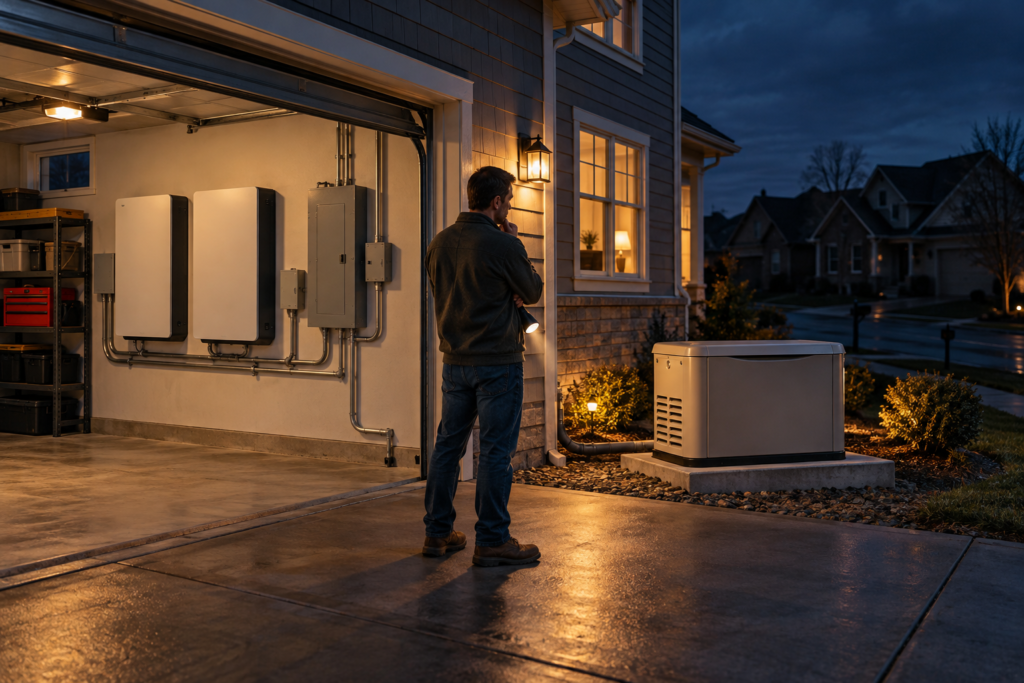
If you’re comparing a whole-home battery vs generator, both can keep essential parts of your house running when the grid goes down—but they solve the problem in very different ways. The right choice depends on what you need to power, how long outages usually last in your area, and how much maintenance or hands-on setup you’re willing to manage.
For some homes, a battery that quietly carries essential circuits through a short outage is the sensible answer. For others—especially where outages can stretch on or happen often—a generator may offer more practical staying power. The key is matching the backup system to your real needs, not buying the biggest box with the most impressive marketing language.
Quick Overview
This guide compares whole-home battery backup systems and generators based on the loads you need to run, likely outage duration, fuel or charging options, installation requirements, and long-term ownership.
Backup power can keep food from spoiling, maintain your connection for work, run medical or accessibility equipment, protect a sump pump, or simply save you from sitting in a dark house wondering whether the coffee maker is worth a hostage negotiation. This guide is for homeowners choosing among a battery system, a generator, and a more limited critical-load setup.
In this guide, “generator” includes both portable generators and permanently installed standby generators. They share the ability to keep producing power while fuel remains available, but their cost, convenience, installation, and safety requirements are very different. A portable generator requires hands-on setup and safe outdoor placement. A standby generator is permanently installed and may start automatically through properly designed transfer equipment.
One important reality: “whole-home” does not automatically mean every circuit in your house can run normally during an outage. According to the National Renewable Energy Laboratory’s guidance on battery storage for resilience, critical loads and anticipated outage duration are central factors in backup-power planning. A system’s output and storage capacity must match the loads you expect it to carry.
What You’ll Need
- Recent electric bills for general energy-use context
- A list of appliances and systems you want available during an outage
- Notes on how long power outages typically last where you live
- Information about existing solar panels, if your home has them
- A realistic budget that includes installation, electrical work, permits, and maintenance
- Your utility’s rules and any local requirements for backup-power equipment
- A qualified installer or electrician for system-specific planning and installation
Before You Begin
Start by separating “nice to have” power from “must have” power. Refrigeration, a few lights, internet equipment, medical devices, a well pump, a garage-door opener, or a sump pump may be critical. Central air conditioning, electric heat, a clothes dryer, an electric range, and every entertainment device in the house may be less realistic during a long outage unless you plan and budget for substantial capacity.
Be honest about your local outage pattern, too. A few brief interruptions each year call for a different solution than multi-day outages caused by storms, fires, or infrastructure problems. A battery may work well for short disruptions and limited essential loads. A generator can be more practical when you need longer runtime and have a dependable fuel plan.
If you already have solar panels, do not assume they will power your home or recharge a battery when the grid is down. Whether solar can support your home or charge a battery during an outage depends on the equipment and installation. Review your system documentation and discuss outage operation with a qualified installer before making assumptions.
Step-by-Step Instructions
Step 1: Decide What “Backup Power” Means for Your Household
Write down what needs to stay powered when the grid is unavailable. Be specific. “Keep the house running” is not a useful planning target; “run the refrigerator, internet router, several lights, a sump pump, and a bedroom outlet” is.
Think through your household’s routine during an outage. If someone works from home, reliable internet and device charging may matter more than powering every room. If your home relies on a well pump, electric heat, refrigerated medication, or a sump pump, those needs should move to the top of the list.
This step prevents a common mistake: shopping for a system before deciding what problem it needs to solve.
Step 2: Separate Critical Loads From High-Demand Loads
Critical loads are the circuits or appliances you truly need during an outage. High-demand loads are those that can overwhelm a modest backup system or quickly shorten its runtime.
A battery setup is often designed around a dedicated critical-load panel rather than every circuit in the home. That can be a practical choice, not a downgrade. It directs available power toward what matters most instead of trying to operate your house as though the grid never went down.
Look carefully at major electric loads. Heating and cooling equipment, electric water heaters, ovens, dryers, and some pumps can require much more power than lights, phones, routers, or a refrigerator. Including those larger loads may require a bigger system, careful load management, or a different backup approach.
When comparing batteries, look at both power output and usable energy capacity. Power output, measured in kilowatts, affects how many demanding loads the system can operate at once. Usable storage, measured in kilowatt-hours, affects how long those loads can run. A battery may store enough energy for several hours but still be unable to start or operate multiple high-demand appliances simultaneously.
Generator ratings require a similar distinction. Running watts describe the load a generator can continuously support, while starting or surge watts account for the brief extra demand created when some motors, pumps, refrigerators, and air conditioners start. Ask the installer to evaluate both—not merely the largest number printed on the equipment.
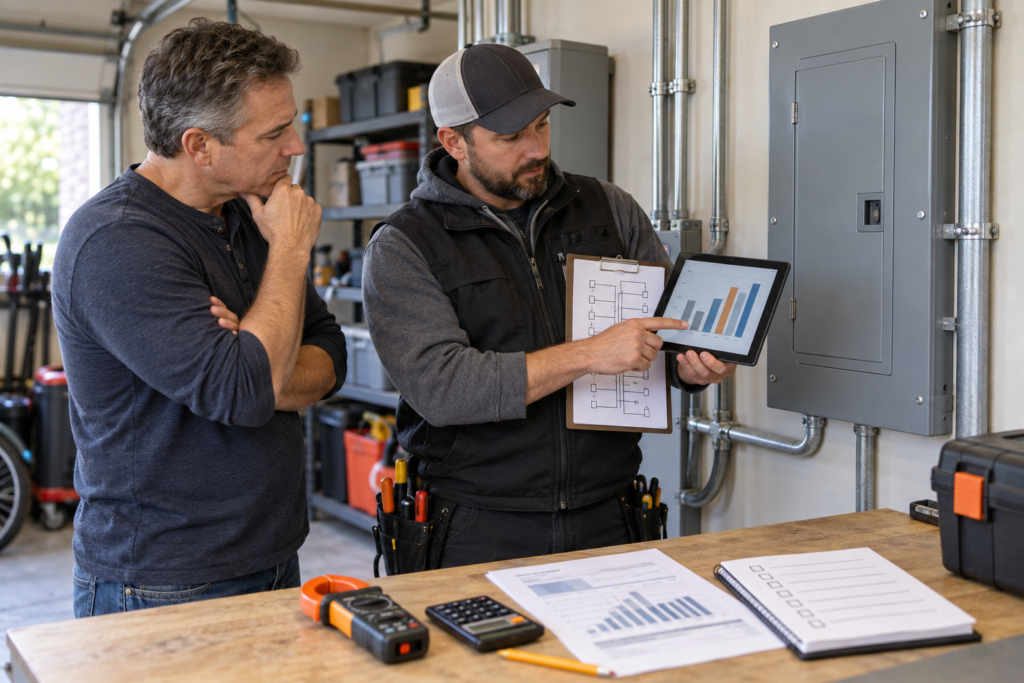
Step 3: Estimate How Long You Need Backup Power
Outage length is one of the clearest dividing lines between a home battery and a generator.
A battery stores a finite amount of energy. Its runtime depends on its state of charge when the outage begins and how much power your household draws. Adding solar may help replenish the battery when conditions and system design allow, but solar production varies and should not be treated as an unlimited emergency fuel tank.
A generator’s runtime is tied more directly to its fuel supply and operating plan. That can make it a better fit for extended outages, provided you can safely and reliably obtain or store the required fuel according to applicable instructions and regulations.
If your typical outage lasts only a few hours, a battery may cover your needs neatly. If outages commonly stretch into days, generator capacity and fuel logistics deserve serious attention.
Step 4: Compare How Each Option Fits Daily Life
A home battery is usually the lower-drama option. It is installed permanently and can provide automatic backup when paired with the appropriate equipment. You do not need to roll it outside in bad weather or refill it with fuel. For households that value quiet operation and convenient short-term backup, that can be a meaningful advantage.
The trade-off is that batteries are not magic bricks full of endless electricity. Running large loads reduces available runtime, and expanding capacity may require additional equipment and installation work.
A generator can offer strong practical value when long outages are the main concern. Portable models may involve less initial expense than permanently installed systems, but they demand more hands-on work. You may need to set up the unit, manage fuel, follow operating instructions, and maintain it even during years when it sits unused.
A standby generator can reduce the manual work, but it is still a mechanical system with fuel, maintenance, installation, and service requirements. It is not a set-it-and-forget-it lawn ornament that happens to make electricity.
Step 5: Consider Fuel, Charging, and Resupply Realistically
A generator only helps while its fuel source remains available. Before choosing one, consider how fuel reaches your property, how you would manage a prolonged regional outage, and whether your household is comfortable with the operating and maintenance responsibilities.
A battery does not require refueling in the same way, but it still needs a charging source. It may recharge from the grid when power returns, and some systems can work with solar when properly configured. During a lengthy outage without adequate solar production, however, its stored energy will eventually run out.
Neither option is automatically more self-sufficient. The practical winner depends on the resources you can count on where you live.
Step 6: Decide Whether You Need Whole-Home Coverage or Critical-Load Coverage
Whole-home backup sounds simple: the power goes out, and life continues. In practice, full-home coverage may require careful management of large loads and a system designed around your home’s electrical demands.
Critical-load coverage is often the better value when your goal is resilience rather than luxury. It can keep the refrigerator cold, lights on in key rooms, devices charged, and essential equipment running without paying to power every unused bedroom outlet or high-demand appliance.
Ask yourself what you would actually miss during an outage. You may not need the entire house operating at full tilt. You need it to remain safe, functional, and reasonably comfortable.
Step 7: Account for Installation, Space, and Maintenance
Both options need a suitable location and professional planning. A battery system requires proper electrical integration and an installation location that meets product instructions and local requirements. A generator needs an appropriate location, electrical connection method, and operating setup that follow manufacturer guidance and applicable local rules.
Do not treat installation as a side note. It affects cost, reliability, ease of use, and whether the system can support the circuits you expect it to run.
Maintenance matters, too. A battery may need less routine hands-on attention, but you should still monitor it according to the manufacturer’s guidance. Generators require regular attention to remain ready, especially if they are expected to start and operate after sitting unused for long periods.
Step 8: Plan for Generator Safety Before an Outage
Portable generators must operate outdoors, never inside a house, garage, basement, shed, crawlspace, or carport. Place the generator at least 20 feet from the home, direct the exhaust away from buildings, and keep it away from doors, windows, and vents. Opening a garage door does not make the garage a safe generator location.
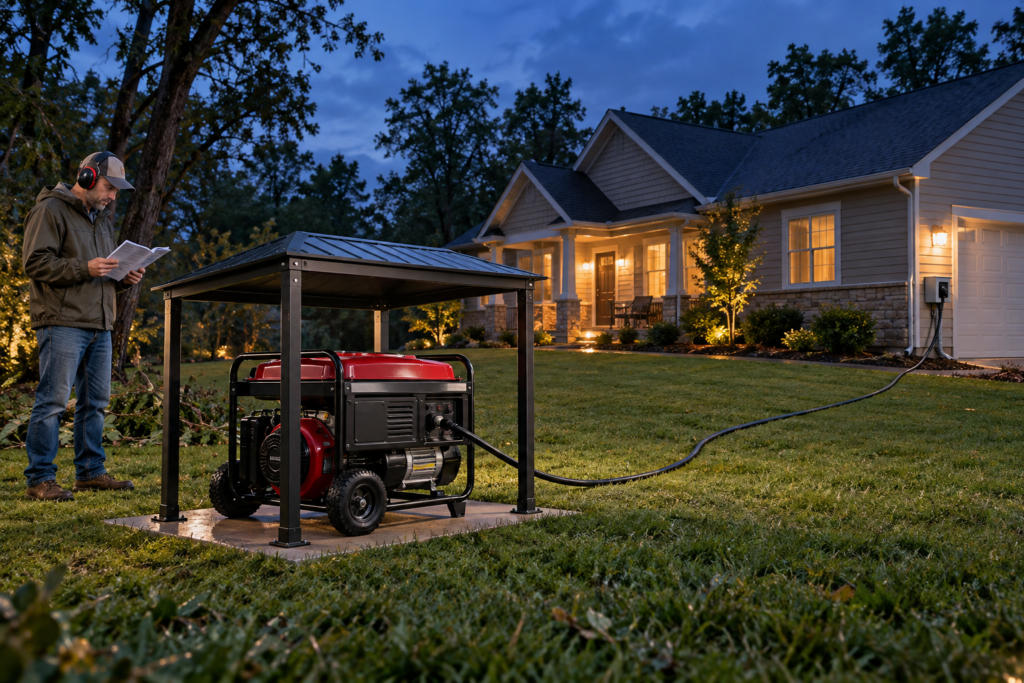
Never connect a portable generator directly to household wiring unless a qualified electrician has installed approved transfer equipment. Improvised connections can send electricity back through utility lines, creating an electrocution hazard for utility workers and a fire or shock hazard at the home.
Plan for weather protection, fuel storage, carbon-monoxide alarms, extension cords, and maintenance before an outage begins. Follow the generator manufacturer’s instructions and all local electrical, fire, and fuel-storage requirements.
Step 9: Choose the Option That Solves Your Actual Outage Problem
A battery may fit best if your outages are usually short, you want quiet automatic backup, and your priority is keeping essential circuits powered without managing fuel. It can also make sense when thoughtfully paired with solar, as long as you understand the limits of both battery storage and solar production.
A generator may fit best if your outages can last a long time, your household needs more power, or you need a backup source that can keep operating with a reliable fuel supply. It may also be the more practical choice when a battery large enough for your needs would exceed your budget.
There is also a middle ground. Some households use a battery for short interruptions and essential electronics while relying on another plan for extended events. The best setup is one you can afford, maintain, and use confidently when the power is out and patience is running low.
Helpful Tips
- Build your plan around the loads that protect health, safety, food, communication, and basic comfort.
- Include everyone in your household when deciding what counts as essential. Their priorities may differ from yours.
- Keep a written outage checklist near your electrical panel or backup equipment.
- Read the operating instructions before an emergency, not while holding a flashlight in your teeth.
- Ask installers to explain in plain language what will and will not run during an outage.
- If you choose critical-load backup, clearly label the supported circuits.
- Revisit your plan after major household changes, such as adding a pump, electric vehicle charger, new heating equipment, or solar panels.
Common Mistakes to Avoid
- Buying based on the “whole-home” label alone. Verify which loads the system can support and for how long.
- Ignoring outage duration. Short interruptions and multi-day outages call for different strategies.
- Assuming solar means unlimited backup power. Solar output and battery-charging capability depend on conditions and system design.
- Forgetting large electric loads. Heating, cooling, water heating, cooking, and drying can change the entire plan.
- Skipping installation planning. Electrical integration, placement, and local requirements are part of the decision—not paperwork to handle afterward.
- Choosing a generator without a fuel plan. A generator is useful only while you can operate it as intended.
- Neglecting maintenance. Backup equipment that is never checked has a bad habit of becoming decorative at the worst possible moment.
Final Thoughts
The better backup-power option is not automatically a battery or a generator. It is the one that keeps your household’s essential systems running through the kind of outage you actually face.
Start with critical loads, be realistic about runtime, and include installation and upkeep in your decision. A smaller, well-planned critical-load system is often more useful than an oversized promise that does not fit your budget or routine.
Frequently Asked Questions
Can a home battery power my entire house?
It can in some installations, but that depends on the battery system’s power output, stored energy, and your home’s electrical loads. Many homes are better served by a critical-load setup that supports essential circuits instead of everything at once.
Is a generator better for long power outages?
A generator can be a practical choice for longer outages because it can continue operating as long as you have an appropriate fuel supply and use the equipment according to its instructions. However, it also requires ongoing maintenance and fuel planning.
Do solar panels work during a power outage?
Not automatically. Whether solar panels can support your home during an outage depends on the system design and whether it includes compatible backup equipment—and, in many cases, battery storage.
Should I choose a battery or generator if I only lose power a few times a year?
Outage frequency alone does not determine the best option. Consider how long those outages last, which loads must remain available, how much hands-on setup you can manage, and what you are willing to spend. A battery offers quiet automatic backup for limited loads, while a portable generator may cost less initially but requires safe setup, fuel, and maintenance. Occasional multi-day outages may still justify a generator or another extended-runtime plan.