
Beginner Guide Overview
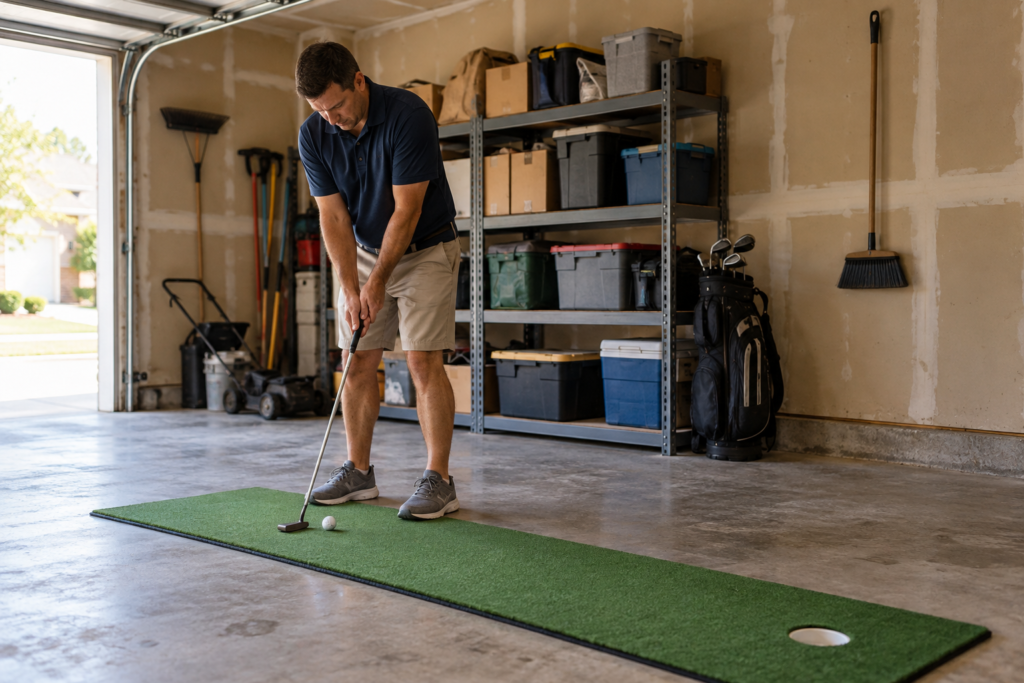
Practicing golf at home in a small space is less about building a mini driving range and more about working on the parts of the game that actually fit: putting, setup, balance, grip, and controlled swing movements. A clear patch of floor, a putter, and a simple target can give you plenty to work with. You don’t need a simulator, a shed full of clubs, or a backyard the size of a fairway.
Beginners often get hung up on the full swing because it looks like “real golf.” But trying to rip drivers in a cramped garage is a quick way to meet your ceiling, your drywall, or both. This guide will help you build a safe at-home practice routine, choose useful equipment, improve the fundamentals, and decide whether a hitting net or larger practice area makes sense.
Understanding the Basics
Focus on Skills That Fit Your Space
Golf includes several distinct skills: putting, chipping, pitching, full swings, and course strategy. In a small indoor area, putting and no-ball swing practice are usually the most practical starting points. Putting is the stroke used on the green to roll the ball toward the hole. It may not look flashy, but it teaches control, aim, and a repeatable setup.
No-ball swing work means rehearsing your grip, posture, takeaway, and finish without striking a golf ball. This is valuable because beginners often need to learn what a balanced, controlled motion feels like before adding the challenge of making contact.
Learn the Difference Between Aim and Speed
A putt needs two things: the right starting line and the right pace. Aim determines where the ball begins rolling. Speed determines how far it travels. A ball can start perfectly on line and still miss because it arrives too fast or too slowly.
Short putting practice helps you work on those skills separately. A tape line on the floor can provide a directional reference, while different target distances teach pace. Keep the goal simple at first: roll the ball smoothly toward a target, not violently past it like it owes you money.
Build a Repeatable Setup
Your setup is how you stand and hold the club before moving it. A repeatable setup makes golf easier because you begin each swing or putt from the same basic position. For putting, stand balanced, let your arms hang naturally, and place the putter behind the ball without reaching or hunching.
For standing swing rehearsals, use a club only if you have enough room to move it safely. Keep your weight balanced, bend slightly from the hips, and avoid trying to create a huge backswing. A compact, controlled practice motion is more useful than a wild one that sends a lamp into early retirement.
Understand Why Feedback Matters
Practice only works when you can tell whether the motion is improving. Feedback can be as simple as noticing whether a putt starts on your intended line, whether the ball rolls smoothly, or whether you can hold your finish without stumbling.
A phone camera can also help. Record a few slow practice swings from the front or side, then look for obvious issues such as poor balance, an uncomfortable posture, or a club that gets dangerously close to furniture. You are not trying to become your own swing coach overnight. You are simply checking that your movement is safe and consistent.
How to Get Started
Step 1: Choose a Safe Practice Spot
Start by finding a spot where you can putt without rolling balls toward stairs, breakables, pets, or feet. A hallway, spare room, garage corner, covered patio, or level section of floor can work well. Carpet is fine for basic stroke practice, though a putting mat or smooth, level floor may provide a more consistent roll.
Before making any standing practice swings, hold the club and move slowly through the entire motion without a ball. Check the ceiling, walls, lights, shelves, and everything else within reach. If the club cannot move freely, stick to putting or rehearse the movement without a club.
Step 2: Set Up a Simple Putting Target
Create one clear target rather than scattering balls around the room. A practice cup, a small container laid on its side, painter’s tape, or a marked spot on a mat can all work. PGA guidance for at-home putting drills shows that a little space, golf balls, painter’s tape, and simple household items can be enough for useful practice games.
For a straight-putt station, place a strip of tape on the floor pointing toward the target. The tape is not there to make the ball obey you. It simply gives your eyes a reference for where you intend to start it.
Step 3: Practice Short Putts First
Begin with short putts that are manageable enough to build confidence and reveal basic mistakes. Set the ball a short distance from the target, make a smooth stroke, and hold your finish for a second. Pay attention to whether the ball starts near your target line.
Give yourself something specific to track. From the same marked spot, roll 10 putts toward your target and count how many finish within a putter-head’s width of it. Repeat the set and compare results. If you use a practice cup, count makes out of 10 attempts. You’re looking for a repeatable stroke, not one lucky putt followed by a victory lap.
Step 4: Add a Gate Drill for Better Aim
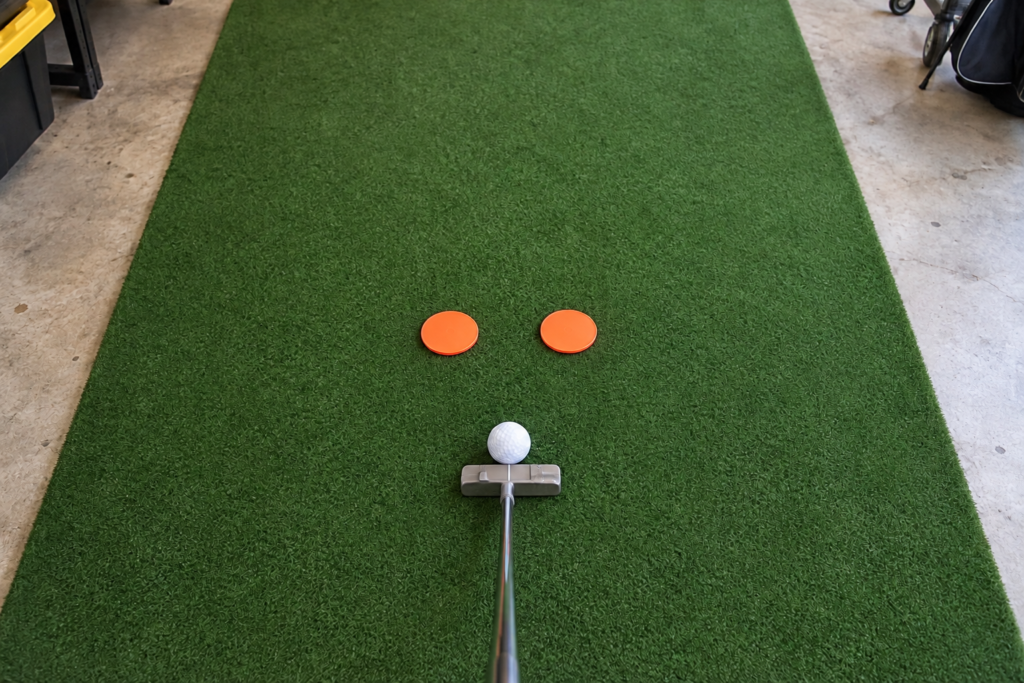
Start with a ball gate to check your starting line. Place two small, soft markers a few inches ahead of the ball, leaving an opening slightly wider than the ball. Aim through the middle and make a smooth putt. If the ball passes between the markers without touching them, it started through the opening you chose. Widen the gate if you’re struggling, then narrow it gradually.
You can also place soft markers beside the putter head at address to check centered contact. Leave enough clearance for a comfortable stroke, and don’t build a long, narrow channel that forces the putter to travel perfectly straight. The gate is a feedback tool, not a set of railroad tracks.
Step 5: Rehearse Your Golf Setup Without a Ball
Practice standing comfortably with relaxed knees and a slight bend from the hips. Let your arms hang naturally rather than reaching forward. If there isn’t safe clearance for a club, rehearse your address position without one.
Where there is adequate room, make slow, controlled no-ball rehearsals using the setup and movement taught in a beginner lesson. Keep the entire intended motion clear of walls, ceilings, furniture, people, and pets. If you have to shorten or redirect the movement to avoid hitting something, switch to club-free setup work or putting.
Step 6: Use Video for Simple Self-Checks
Prop up your phone safely and record a handful of practice motions. Review only a couple of basics: Are you balanced? Is your posture reasonably comfortable? Can you finish the movement without shifting wildly or losing control?
Avoid pausing every frame and diagnosing seventeen imaginary flaws. Early on, video is best used to spot big, obvious patterns. If you want more detailed swing guidance later, a qualified golf instructor can help you separate useful changes from internet noise.
Step 7: Consider a Net Only When the Space Is Truly Suitable
A hitting net can make at-home practice more versatile, but it does not automatically make a small area safe for full swings. Before hitting any ball into a net or screen, confirm that you have unobstructed swing and ceiling clearance. Remove breakable items and keep people and pets out of the area.
Garmin’s indoor-use guidance for launch-monitor setups also warns that a net or screen needs clear space behind it, enough height and width for lofted or errant shots, and padded framing to reduce ricochet risk. Requirements vary by equipment and room, so there is no universal minimum garage size. If anything feels tight, skip ball striking and practice putting or controlled movement instead.
What Beginners Need
- Putter: The essential club for small-space golf practice. Any putter that fits you reasonably well is enough to begin.
- A few golf balls: Use standard golf balls for putting if the area is safe. Softer practice balls may be useful for certain controlled drills, but they do not behave exactly like standard balls.
- A flat practice surface: A putting mat is convenient, but a clear strip of hard floor or low-pile carpet can work for basic drills.
- Painter’s tape or small markers: Useful for making target lines, gates, distance markers, and practice boxes without turning the room into a permanent golf course.
- A target: A putting cup, small container, or marked spot gives each putt a destination and makes practice measurable.
- Phone camera: Optional but useful for reviewing posture, balance, and controlled no-ball swing rehearsals.
- Putting mat with alignment markings: An optional upgrade that can provide a more consistent surface and built-in targets.
- Hitting net and mat: Optional and suitable only for a properly cleared, safety-checked space. A net is not a substitute for adequate room and careful setup.
- Golf instruction resource: A beginner lesson, reliable coaching video, or local teaching professional can help when you are ready to learn grip, stance, and swing fundamentals in more detail.
Common Beginner Mistakes
- Trying to practice full swings in a cramped room: Full swings may feel like the main event, but limited clearance creates safety risks and encourages tense, awkward movement. Choose putting and no-ball drills unless you can make an unobstructed swing in a properly prepared hitting area.
- Hitting the same putt repeatedly without a goal: Random practice can feel productive while teaching very little. Use a target number, distance, or gate drill so you know what you are trying to improve.
- Practicing too fast: Beginners often rush because they want quick results. Slow down, reset your stance, and make each repetition deliberate. Good habits are easier to build at a controlled pace.
- Using only one distance: Short putts build confidence, but golf also requires pace control. Once a short distance feels comfortable, add a longer target and learn how a slightly bigger stroke changes the roll.
- Ignoring balance and posture: It is easy to focus only on where the ball goes. A balanced setup and controlled finish make your movements easier to repeat, including your putting stroke.
- Buying too much gear too soon: Practice equipment can be useful, but it cannot replace a clear target and focused repetitions. Start simple, then upgrade once you know what kind of practice you will actually use.
What to Expect
Home practice can improve your comfort with a putter, your ability to start short putts on line, and your awareness of basic setup and balance. Progress is usually uneven. One day the stroke feels easy; the next, the ball seems determined to find the one crooked seam in the floor. That is normal. The useful measure is whether your setup, stroke, and contact become more consistent over several sessions.
A small-space setup also has limits. It cannot fully replace seeing real ball flight, playing uneven lies, or learning how different clubs behave outdoors. Even a basic net setup may not show whether shots would curve, climb, or land where intended. Think of home practice as a way to build useful habits between trips to a practice green, driving range, or golf course.
Where to Go From Here
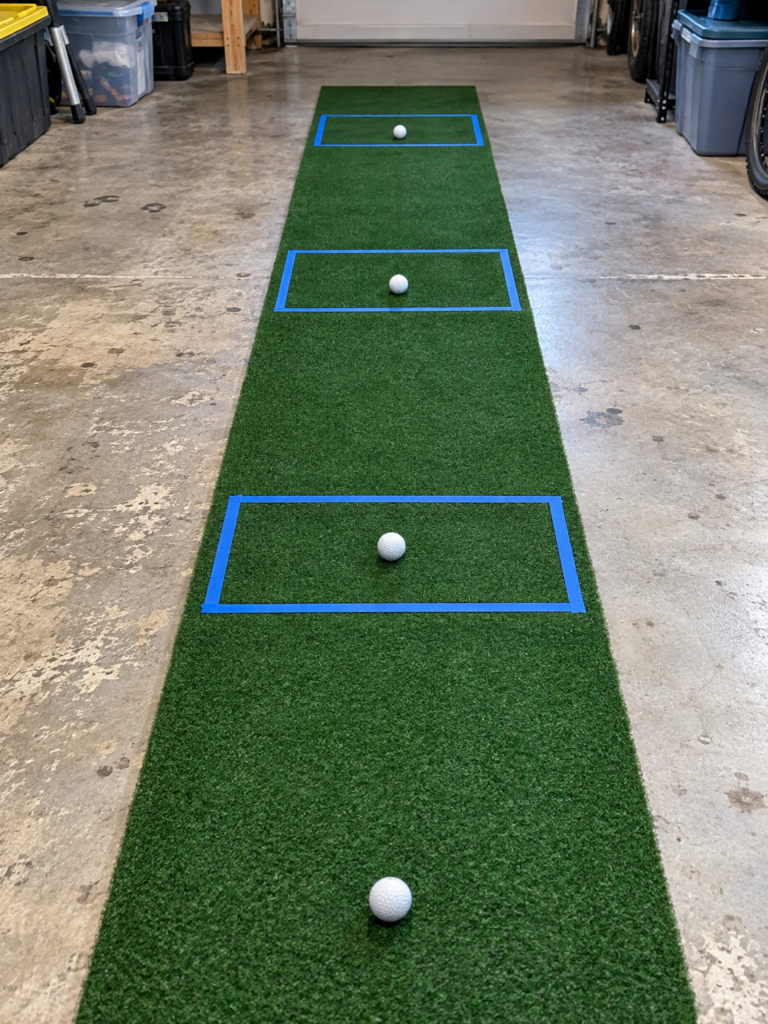
Once short putting feels more natural, add a simple distance-control drill. Mark two or three target zones along your available putting space and alternate between them, trying to stop the ball inside each zone. Track how many attempts finish where intended. Your floor won’t reproduce a real green’s speed, but it gives you a consistent place to practice controlling the roll. Save learning to read slopes for a practice green.
The next logical step is taking those basics outside. A practice green lets you see how slopes affect a rolling ball, while a driving range provides room to learn chipping, pitching, and full swings. A beginner lesson can be especially helpful once you have a few home sessions under your belt because you will arrive with better awareness of your grip, posture, and questions.
Frequently Asked Questions
Can you practice golf at home without a net?
Yes. Putting, setup drills, balance work, and no-ball swing rehearsals can all be useful in a small space. A net is optional, not required.
Is carpet good for putting practice?
Carpet can help you practice your stroke and starting line, but it may roll differently from a putting green. A putting mat or smooth, level floor usually provides more consistent feedback.
How long should a beginner practice at home?
Try a manageable 10-minute session: two minutes settling into your putting setup, four minutes working on starting line, and four minutes putting toward different distance targets. Adjust that split to suit your space and attention. Stop when you’re rushing or losing focus; useful repetitions beat staying longer just to say you practiced.
Can I use foam balls for indoor golf practice?
Foam balls may be useful for limited, controlled drills, but they do not react like standard golf balls. They should not be treated as a reason to swing freely in a space without proper clearance.