
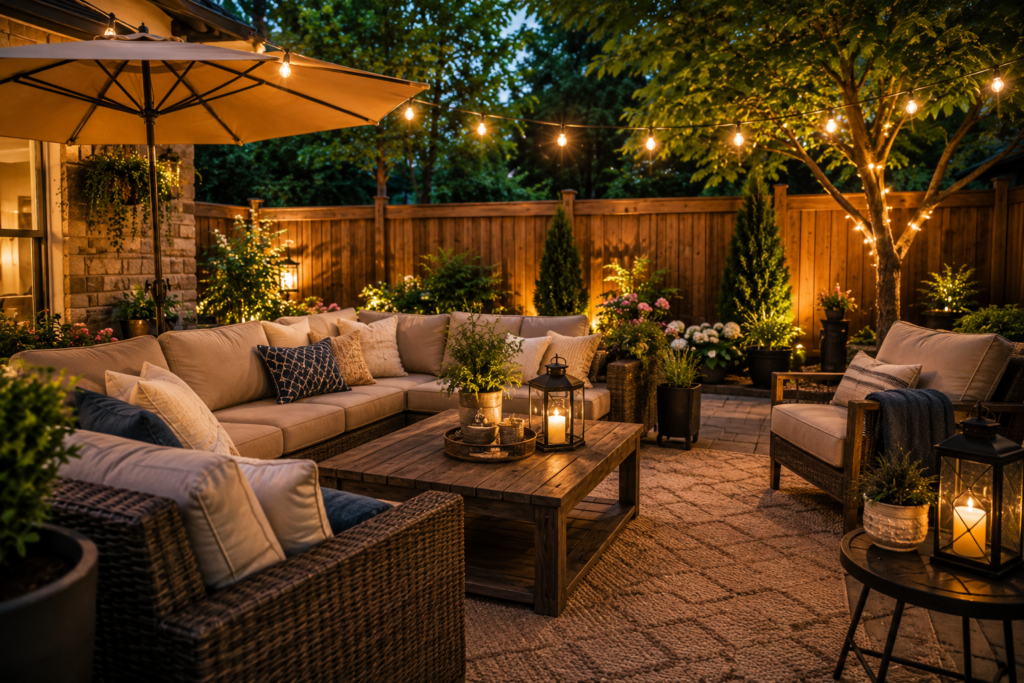
You don’t need a sprawling patio, a custom pergola, or a backyard that looks like it belongs on HGTV to create a cozy backyard lounge area you actually want to use.
Sometimes the problem isn’t the backyard.
It’s the lonely collection of chairs shoved against the house, the table nobody can reach from those chairs, and the porch light bright enough to interrogate a suspect.
A weekend is plenty of time to fix that.
This project isn’t about building an outdoor living room from scratch. We’re taking a patio, deck, porch, or forgotten corner of the yard and turning it into a comfortable place to drink coffee, read, hang out with friends, or sit outside after dinner without immediately wondering why you bothered.
Affiliate disclosure: Some links in this article are affiliate links. If you make a purchase through an affiliate link, I may earn a commission at no additional cost to you. As an Amazon Associate I earn from qualifying purchases.
What We’re Actually Doing
The goal is simple: create a defined outdoor conversation and relaxation area using some combination of seating, tables, shade, lighting, textiles, greenery, and privacy.
You may already own half of what you need.
Before buying anything, we’re going to figure out how you want to use the space, work with what you have, and spend money only where it makes the biggest difference.
This can work on a small apartment patio just as easily as a large backyard. The scale changes. The basic principles don’t.
Start With How You Actually Want to Use It
Don’t begin at the store.
Begin outside.
Stand in the space and ask yourself what you’d realistically do there.
Morning coffee for two?
Evening drinks with friends?
Reading?
Watching the kids play?
Sitting around a fire pit?
Outdoor meals?
Those aren’t necessarily the same setup.
A couple who wants a quiet morning coffee spot may need two comfortable chairs and a small table. Someone who regularly has six friends over needs conversation seating and several places to put drinks.
Design for your life, not the patio display at the store.
Watch the Space for a Day Before You Commit
Here’s an easy mistake: choosing your lounge area at 9 a.m. because it’s beautifully shaded.
Come back at 5 p.m.
You may discover you’ve accidentally selected the surface of the sun.
Before moving heavy furniture or buying anything permanent, pay attention to the space at the times you’re most likely to use it.
Look at:
- Morning and afternoon sun
- Natural shade
- Wind direction
- Privacy from neighbors or the street
- Nearby doors and walkways
- Drainage after rain
- Mosquito-prone areas
- Views you want to enjoy—or hide
You might find that moving the entire setup ten feet gives you better shade, more privacy, and a much nicer view.
That’s considerably cheaper than buying a pergola because the chairs were in the wrong place.
Measure Before You Shop
Now the tape measure gets to participate.
Measure the usable area and jot down the dimensions.
Also measure any furniture you’re keeping.
A sofa that looks perfectly reasonable in a giant showroom can consume a small patio with astonishing efficiency.
Painter’s tape, chalk, cardboard, or even strategically placed objects can help you mark out prospective furniture dimensions before ordering anything.
Then walk through it.
Can you comfortably reach the door?
Can someone walk past the chairs?
Can you get to the grill?
Does pulling a chair out block everything?
A lounge area should feel inviting—not like an obstacle course somebody decorated with throw pillows.
Give the Space a Center
Outdoor spaces often feel awkward because the furniture has no relationship to anything else.
Give yours a focal point.
That might be:
- A coffee table
- A fire pit
- An outdoor rug
- A great view
- A large planter
- A small fountain
- A conversation area
- An outdoor fireplace
Then arrange the seating around that purpose.
For conversation, turn chairs toward one another, not simply toward the nearest fence.
Unless you’re expecting everyone to sit silently and contemplate the fence.
In that case, carry on. 😂
Use the Seating You Already Have First
Before buying a $2,000 outdoor sectional because Pinterest made you temporarily lose your senses, drag out what you already own.
Clean it.
Move it around.
Try different combinations.
Two chairs that felt completely unrelated on opposite sides of the patio may suddenly work when angled toward one another with a small table between them.
If your existing furniture is structurally sound but tired, new outdoor cushions or a fresh finish may completely change it.
Save the furniture budget until you know what the space actually needs.
If new seating is part of the plan, a cushioned outdoor sectional can create the same cozy, conversation-friendly setup shown here while giving several people a comfortable place to sit. You can browse similar patio furniture on Amazon to compare sectional sizes and layouts before choosing one that fits your space.
Comfort Matters More Than Matching
An outdoor lounge needs to be somewhere people voluntarily stay.
That means the chair you love looking at but hate sitting in probably shouldn’t be the star.
Sit in your furniture.
Really.
Is the seat deep enough? Does the back provide support? Are the arms comfortable? Can you get out of it without performing a squat challenge?
For lounge seating, comfort should beat perfect matching every time.
A coordinated space is nice.
A coordinated space everyone abandons after twelve minutes is considerably less impressive.
Don’t Buy Cushions Until You Measure
Outdoor cushions are not universally sized.
Measure the seat width, depth, and back area before ordering replacements.
Pay attention to thickness too. A cushion that’s several inches thicker than the original can change the seat height and back position enough to make comfortable furniture strangely uncomfortable.
Look for materials intended for outdoor use and check the manufacturer’s care instructions.
Even outdoor cushions generally last longer when they aren’t left sitting in standing water for three months.
Which brings us to storage.
Decide Where the Cushions Are Going When You’re Not Using Them
This is one of those boring details that becomes very important approximately five minutes before a thunderstorm.
Where will cushions, throws, and other weather-sensitive accessories go?
Possible solutions include a weather-appropriate deck box, garage shelving, covered porch storage, shed space, or another dry location.
Plan this before buying twelve enormous cushions.
Otherwise your new outdoor lounge may come with a complimentary indoor lounge consisting entirely of cushions stacked in your living room.
Put a Table Within Reach
This sounds almost insultingly obvious.
And yet.
Sit in each main seat and ask:
Where would I put a drink?
If the answer involves standing up, stretching four feet, or balancing it on the armrest, you need another surface.
You don’t necessarily need a giant coffee table. Small side tables, garden stools, compact drink tables, or other weather-suitable surfaces can work beautifully.
One useful surface beside each pair of seats can make the area dramatically more functional.
Coffee deserves somewhere to live.
An Outdoor Rug Can Define the Whole Area
If the lounge sits on a deck, patio, or covered porch, an outdoor rug can visually tie unrelated pieces of furniture into a cohesive space.
Choose a rug designed for outdoor use and appropriate for the surface beneath it.
Size matters.
A tiny rug floating between large pieces of furniture can make the entire arrangement look disconnected. Generally, you want the rug large enough to visually anchor the seating arrangement rather than resemble a decorative postage stamp.
And remember that rugs can trap moisture or debris beneath them depending on the material, surface, and environment. Lift and clean underneath periodically instead of assuming “outdoor” means “never think about this again.”
Fix the Shade Problem
A cozy lounge that’s unusable during the hottest part of the day isn’t particularly useful.
Your shade solution depends on the space and budget.
Options might include:
- Existing trees
- A patio umbrella
- A cantilever umbrella
- A retractable awning
- A properly installed shade sail
- An existing covered patio
- A pergola or other permanent structure as a future project
For a simple weekend makeover, an umbrella is often the easiest solution.
Before buying one, consider both the shade it creates and where the base has to sit.
A huge umbrella isn’t much help if its stand consumes the only useful walking path.
And secure umbrellas according to their manufacturer’s instructions. Wind can turn innocent patio accessories into surprisingly ambitious aircraft.
Lighting Is Where “Patio” Starts Feeling Like “Lounge”
One glaring fixture mounted beside the back door may provide light.
It does not necessarily provide ambiance.
Use layers instead.
You might combine low-level pathway lighting with warm string lights, rechargeable table lamps, lantern-style lights, or other outdoor-rated fixtures around the seating area.
The goal isn’t to make midnight look like noon.
You need enough light to see where you’re walking, recognize the person sitting across from you, and locate your drink without turning the backyard into a stadium.
For plug-in lighting, use products and electrical connections specifically rated for outdoor use, and follow the manufacturer’s instructions. Don’t run indoor extension cords outside because they happened to be in the garage.
If permanent wiring or new electrical work is needed, that’s no longer our cute little weekend decorating project.
Call the appropriate professional.
See? We have boundaries. 😁
Add Privacy Without Building a Fortress
A lounge feels considerably less relaxing when you’re making direct eye contact with your neighbor every time either of you opens the back door.

You don’t necessarily need a new fence.
Depending on the space, privacy can come from:
- Tall planters
- Outdoor curtains in appropriate covered locations
- Freestanding outdoor privacy screens
- Trellises
- Existing landscaping
- Container-grown plants
- Strategic furniture placement
Think about where privacy is actually needed rather than surrounding the entire area.
Sometimes blocking one awkward sightline is enough to make a patio feel much more secluded.
Use Plants to Soften the Hard Stuff
Furniture + concrete + fence can feel a little…parking lot.
Plants help.
Large containers can anchor corners. Smaller pots can soften tables and steps. Existing garden beds can become part of the lounge rather than something separate from it.
Choose plants suited to the amount of sun the location actually receives and your climate.
If maintaining seventeen needy potted plants sounds like punishment rather than relaxation, don’t buy seventeen needy potted plants.
“Low maintenance” is a perfectly respectable design style.
Think About Bugs Before They Arrive
Nothing says relaxing evening outdoors quite like slapping yourself every thirty seconds.
Reduce standing water around the lounge area and pay attention to obvious mosquito breeding spots.
Air movement can also make a seating area more comfortable in warm weather. Depending on the location, an outdoor-rated fan may be useful when installed and used appropriately.
For pest-control products or devices, follow their labels and manufacturer directions.
And if your backyard has a significant pest problem, deal with the problem itself rather than surround the furniture with seventeen mysterious internet gadgets and hope mosquitoes respect technology.
Be Smart About Fire Features
A fire pit can make an outdoor lounge fantastic.
It can also change the safety requirements of the entire layout.
If you’re adding one, follow the fire feature manufacturer’s instructions and applicable local rules for placement, clearances, surfaces, overhead structures, combustible materials, and operation.
Don’t guess at safe distances.
Don’t tuck a fire pit beneath something simply because it looks fantastic in a staged photograph.
And don’t assume every deck or patio surface is appropriate for every type of fire feature.
If the fire pit already exists, arrange the lounge around its required clearances, not the other way around.
Saturday: Build the Bones of the Space
Here’s how I’d tackle the weekend.
Saturday morning: Empty or partially clear the area. Clean the patio/deck as appropriate, remove junk, trim minor vegetation if needed, and handle obvious maintenance.
Then mark your usable area and decide on the focal point.
Saturday afternoon: Arrange the largest furniture first.
Start with the main sofa, loveseat, chairs, or whatever anchors the lounge. Then add tables and test the traffic paths.
Actually sit down.
Move things.
Sit again.
You are not legally obligated to keep a chair somewhere because that’s where you put it first.
By Saturday evening, the space should be functional even if it isn’t pretty yet.
Sunday: Make It Somewhere You Want to Stay
Sunday is where the personality shows up.
Add:
- Outdoor cushions
- Rug
- Shade
- Side tables
- Lighting
- Plants
- Privacy elements
- Storage
- A few decorative pieces
But don’t fill every available surface.
The goal is a comfortable outdoor room, not the seasonal aisle after someone yelled “FREE DECOR”.
When you’re finished, sit down with an actual drink and use the space for a while.
You’ll immediately notice whether something needs moving.
Three Ways to Approach the Budget
Instead of pretending every backyard lounge costs somewhere between $200 and $600, decide where your money actually needs to go.
Use What You Have
Rearrange existing furniture, deep-clean the space, relocate plants, bring out appropriate accessories you already own, and spend only on one or two things that solve obvious problems.
A new side table and better lighting might be all the space needed.
Comfort Upgrade
Keep the major furniture but invest in better cushions, an outdoor rug, shade, lighting, tables, or storage.
This is often where you get the biggest transformation without having to replace everything.
Bigger Refresh
If your existing furniture is uncomfortable, damaged, or nonexistent, put most of the budget into good seating first.
Then build around it over time.
You don’t have to finish the Pinterest fantasy in one weekend.
A comfortable chair today beats a coordinated collection of uncomfortable junk forever.
Common Mistakes That Make Outdoor Lounges Less Comfortable
A few things can sabotage an otherwise great setup:
- Buying furniture before measuring the space
- Ignoring afternoon sun
- Blocking natural walkways
- Putting every chair against a wall or fence
- Forgetting tables for drinks
- Buying cushions before measuring
- Having nowhere to store soft goods
- Using one harsh light as the entire lighting plan
- Choosing appearance over seating comfort
- Buying indoor products for exposed outdoor use
- Forgetting wind when adding umbrellas and lightweight decor
- Crowding the space with too much stuff
And perhaps the biggest one:
Trying to make the backyard look like somebody else’s backyard.
Build around how you use it.
The Five-Minute Lounge Test
Before declaring victory, sit in the space and check five things:
Can I get comfortable?
Can I set down a drink?
Can people talk without shouting across the patio?
Can someone walk through without moving furniture?
Would I voluntarily stay here for an hour?
If the last answer is no, figure out why.
Too hot? Fix shade.
Too exposed? Add privacy.
Uncomfortable? Fix seating.
Too dark? Improve lighting.
Mosquito convention? Address that.
The best outdoor lounge isn’t the most expensive one.
It’s the one you actually use.
Final Thoughts
A cozy backyard lounge doesn’t need to begin with a construction project.
Start with the space you have. Figure out when and how you want to use it. Pay attention to sun, shade, privacy, traffic flow, and weather. Arrange comfortable seating around a purpose, put tables where humans can actually reach them, and add lighting that doesn’t make everyone feel like they’re being questioned.
Then stop.
Seriously.
You don’t have to add every outdoor-living idea you’ve ever saved.
Sometimes a couple of comfortable chairs, somewhere to put your coffee, good shade, a few plants, and warm lighting are enough to turn a neglected corner into the best seat at the house.
And the real test comes Monday evening.
If you find yourself outside using it instead of looking at it through the window?
Weekend project accomplished.
Frequently Asked Questions
How can I make a small patio feel cozy without overcrowding it?
Choose appropriately scaled furniture and prioritize pieces that serve a real purpose. A pair of comfortable chairs, one useful table, a few plants, and good lighting can create a complete lounge without filling every square foot.
What’s the most important thing to buy for an outdoor lounge?
If you need new furniture, prioritize comfortable, appropriately sized seating. Everything else can be added around it. If you already have good seating, spend money on fixing the space’s biggest problem—whether that’s shade, lighting, privacy, or a place to put a drink.
Do I need an outdoor rug?
No. Rugs are useful for visually defining a seating area, particularly on large patios or decks, but they’re not required. Your furniture arrangement can define the lounge perfectly well without one.
How can I make an outdoor lounge more comfortable in hot weather?
Start with shade and airflow. Pay attention to when direct sun hits the space, consider an appropriate umbrella or existing shade, and use outdoor-rated fans where suitable. Choose breathable seating materials and avoid arranging the lounge in a way that reflects heat and makes it miserable.
How do I make an outdoor lounge feel cozy at night?
Use several softer, outdoor-appropriate light sources rather than relying solely on one bright overhead fixture. String lights, lantern-style fixtures, rechargeable table lamps, and low pathway lighting can create a much warmer atmosphere while still keeping the area usable.