
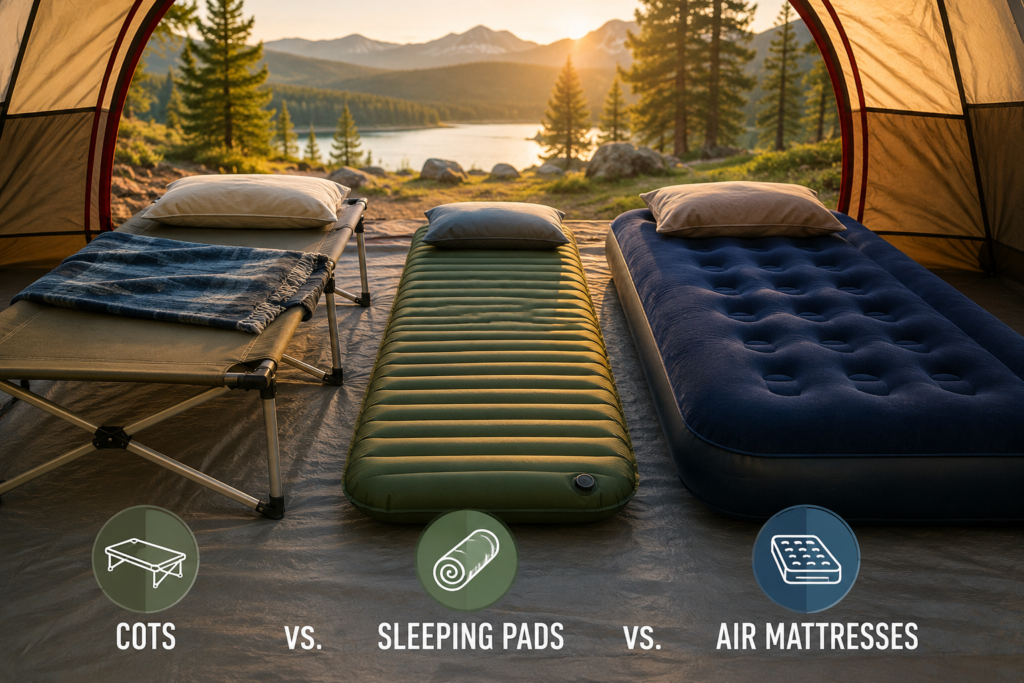
Camping cots, sleeping pads, and air mattresses can all turn a tent floor into a reasonable place to sleep, but they solve the problem in different ways. A cot keeps you off the ground, a sleeping pad adds insulation and cushioning, and an air mattress aims for a more bed-like feel. The most comfortable choice depends on what “comfortable” means for your trip: pressure relief, warmth, ease of getting up, room to move, or simply not hearing rocks argue with your spine all night.
When trying to choose a camping sleep system, there is no universal camp-bed champion. A thick air mattress may feel luxurious at a drive-in campsite but be impractical at a hike-in site. A sleeping pad can be warm, compact, and surprisingly supportive, yet it may not suit someone who struggles to get up from ground level. Cots provide elevation and steady support, though they take up more room and generally belong in car-camping territory.
Affiliate disclosure: Some links in this article are affiliate links. If you make a purchase through an affiliate link, I may earn a commission at no additional cost to you. As an Amazon Associate I earn from qualifying purchases.
Camping Sleep Systems Comparison Overview
Camping cots, sleeping pads, and air mattresses are commonly compared because each makes sleeping outdoors more tolerable than lying directly on the ground. They also overlap in how they can be used. Any of the three may work in a tent, cabin, vehicle setup, or temporary guest arrangement, depending on its size and design. That overlap can make the choice look simpler than it is.
The main differences come down to insulation, portability, setup, and sleeping height. Sleeping pads are typically the strongest option when warmth and packability matter. Cots are appealing when you want elevated support and easier entry and exit. Air mattresses can provide generous cushioning and a familiar surface, but they require inflation and may be less reliable when temperatures change or a leak enters the chat.
Looking for Generous Cushioning? Check out this Air Mattress
Side-by-Side Comparison
| Criteria | Camping Cot | Sleeping Pad | Air Mattress |
|---|---|---|---|
| Sleeping position | Elevated above the ground | Directly on the tent floor or ground surface | Usually directly on the tent floor or ground surface |
| Cushioning | Depends on cot fabric and any added pad | Ranges from minimal to heavily cushioned | Often provides a thicker, softer surface |
| Insulation from cold ground | Limited on its own because air circulates underneath | Designed to provide insulation in many camping setups | Can feel cold without added insulation beneath or above it |
| Portability | Usually bulkier and heavier | Often the most packable option | Varies, but requires an inflation method and packed volume |
| Setup | Requires unfolding or assembling a frame | Usually unrolls, self-inflates, or inflates manually | Requires inflation and occasional topping off |
| Ease of getting up | Generally easier due to raised height | Lowest to the ground | Low to moderate height, depending on design |
| Best fit | Car camping, base camps, and users wanting elevation | Backpacking, cold-weather camping, and limited-space trips | Car camping, glamping, and comfort-focused overnight use |
Key Differences
Height Off the Ground
A camping cot’s defining advantage is elevation. Being raised off the tent floor can make it easier to sit down, stand up, and avoid uneven ground beneath your sleeping surface. That matters if mobility, stiff joints, or simple middle-of-the-night convenience are part of the equation.
Sleeping pads and most air mattresses keep you much closer to the ground. That can be perfectly comfortable, but getting up requires more bending and pushing yourself upright. In a low tent, a cot can also make changing clothes more awkward because you are already closer to the ceiling. Camp furniture always finds a way to negotiate with tent geometry.
Warmth and Ground Insulation
Sleeping pads are the clearest choice when cold ground is a serious concern. Their job is not just to provide softness; they also help reduce heat loss from your body to the ground. A pad’s insulation can matter as much as its thickness when overnight temperatures dip.
Cots create a different challenge. Because air moves beneath the sleeping surface, a cot can feel chilly without a pad, blanket, or insulated layer on top. Air mattresses may also feel cool because the large air chamber beneath you can draw away warmth. In cool conditions, comfort requires thinking beyond how soft the surface feels at bedtime.
Support and Pressure Relief
A cot provides taut, even support across a frame. You may appreciate that firmer, flatter feel, especially when the ground is rough or uneven. On the other hand, the fabric surface may feel too firm unless you add a sleeping pad or blanket for cushioning.
Sleeping pads range from thin closed-cell foam to thick inflatable models. A suitable pad can support side sleepers and reduce pressure at the shoulders and hips while remaining much more compact than a cot. Air mattresses usually offer the most familiar plush feel, but their comfort depends heavily on inflation. Too firm feels like a raft; too soft can leave you sagging toward the middle.
Space Inside the Tent
Cots have legs, frames, and a larger practical footprint than their sleeping surface alone suggests. In a roomy tent, that can be manageable and even useful because you may be able to store gear underneath. In a smaller tent, however, cot legs and crossbars can turn setup into a game of campsite Tetris.
Pads are the simplest choice for tight spaces. They follow the floor plan and can be placed close together when several people share a tent. Air mattresses also take up considerable floor space, especially larger models, and their height can make a tent feel crowded even when the floor dimensions technically work.
Weight, Packed Size, and Complexity
If you must carry your gear any meaningful distance, sleeping pads are generally the practical choice. Foam pads need no inflation, while inflatable and self-inflating pads can pack down small but require more care. They are built around the simple reality that backpacking gear has to earn its place.
Cots are better suited to vehicle-supported camping because of their frames and bulk. Air mattresses may pack smaller than cots, but you still need a pump, power source, batteries, or manual effort, depending on the setup. Neither option is automatically difficult to use, but neither is the obvious answer when every ounce and cubic inch matters.

Performance and Everyday Use
Car Camping and Established Campgrounds
For car camping, all three options are viable. A cot works well if you value a raised bed, gear storage underneath, and a stable surface. Pairing it with a pad can improve warmth and cushioning, creating a setup that may be more comfortable than either item alone.
Air mattresses also make sense because transportation is less of a concern. They can feel inviting after a long day outdoors, especially if you are accustomed to a softer bed. A sleeping pad remains the simpler option, though, and it avoids the extra pump, inflation time, and chance of waking up slightly lower than where you started.
Backpacking and Walk-In Campsites
Sleeping pads are usually the sensible choice when you must carry your sleep system. They provide insulation and comfort without requiring a metal frame or large air chamber. A foam pad is especially straightforward, while an inflatable pad offers more cushioning in a compact package.
When a Sleeping Pad is the Sensible Choice
Camping cots and full-size air mattresses are generally harder to justify for these trips. Lightweight cots are available, but they still add bulk and setup complexity compared with a pad. An air mattress can also be a poor fit when a pump, repair kit, and extra packed volume become part of your loadout.
Uneven Ground and Rough Campsites
A cot can shine over roots, small rocks, and uneven terrain because your body is suspended above the ground. That benefit is real, although the cot itself still needs reasonably level footing. A wobbly cot on loose soil is not a comfort feature.
A sleeping pad follows the ground beneath it, so site selection matters more. Clearing sticks, stones, and sharp debris before pitching the tent improves comfort and helps protect the pad. Air mattresses offer more thickness over minor lumps, but they are not immune to rough terrain and can feel unstable on a slope.
Couples, Families, and Shared Tents
Sleeping pads are often easiest when several people need to fit inside one tent. Individual pads allow each sleeper to manage their own comfort and minimize the rolling, bouncing, and general bedtime diplomacy that can come with a shared air mattress.
A large air mattress can be appealing for couples who want a broader sleeping surface, provided the tent can accommodate it. Cots are more individual by nature and can work well for family camping when each person has a designated sleep space. Their frames can also make bedtime arrangements more structured, for better or worse.
Durability and Maintenance
Camping cots rely on fabric, joints, legs, and frame hardware, so it makes sense to keep dirt out of moving parts and check for bent or damaged components. Cot fabric can wear over time, particularly if the cot is overloaded or dragged across rough surfaces. Repairs may involve replacing the fabric deck, hardware, or part of the frame, depending on the cot’s construction and available parts.
Sleeping pads and air mattresses are more vulnerable to punctures, valve trouble, and abrasion. A groundsheet, clean tent floor, and careful packing go a long way toward preventing damage. Small leaks can sometimes be patched, but success depends on finding the leak and using a compatible repair method. Foam pads are generally the least fussy option because they have no valves or air chambers to maintain.
Cost and Overall Value
Value depends on how often you camp, how you travel, and which discomfort you are trying to eliminate. A basic sleeping pad may be enough for occasional fair-weather camping, while a more insulated or thicker pad can justify its cost if you camp frequently, sleep on your side, or head out in colder conditions. Its versatility across backpacking and car camping can make it a strong long-term purchase.
A cot may cost more than a basic pad because it includes a frame and hardware, but it can be worthwhile if you prioritize elevation and easier movement. An air mattress can offer plenty of comfort for casual car camping, especially if you already have a reliable way to inflate it. Spending more makes sense when it buys the specific feature you need—not just a bigger promise printed on the box.
Who Should Choose Each Option
Backpackers and Minimalist Campers
A sleeping pad is the better fit for most backpackers and walk-in campers. It offers the most practical blend of insulation, low weight, and packing efficiency. Choose a style with enough cushioning for your preferred sleeping position, but do not overlook insulation if your trips include cool nights.
Campers Who Need Easier Entry and Exit
A camping cot is often the better match if getting up from the ground is uncomfortable or inconvenient. The raised surface can make nighttime trips outside less of a production, and the firm support may appeal to you if you dislike sinking into an inflatable surface.
Cold-Weather Campers
A sleeping pad with suitable insulation is generally the best starting point for cold conditions because it directly addresses heat loss to the ground. You can still use a cot or air mattress, but both typically benefit from an insulated layer to keep the sleeping surface from feeling cold.
Comfort-Focused Car Campers
An air mattress can be the right choice when your campsite is vehicle-accessible and you want a soft, roomy, bed-like surface. It is especially practical when packed size and setup gear are not major concerns. Add an insulating layer beneath or above it in cool weather for better comfort.
Campers on Uneven or Rocky Ground
A cot is usually the strongest option when the terrain is rough but the campsite has enough room for a stable setup. It separates your body from minor surface irregularities. If packing space is limited, a thicker sleeping pad can still work, but careful campsite preparation becomes more important.

Final Verdict
The most comfortable camping sleep setup depends on where you camp and how you sleep. Choose a sleeping pad when insulation, portability, and efficient packing matter most. Pick a cot when you want a raised, supportive surface and do not mind carrying more gear. Consider an air mattress when you are car camping and want the most bed-like cushioning.
For many campers, the best answer is not strictly cot versus sleeping pad versus air mattress. A cot paired with a pad can offer elevation, warmth, and cushioning, while a pad alone may be all you need for a lighter trip. Match your system to the terrain, temperature, tent size, and tolerance for setup chores. Comfort in the woods is rarely magic; it is usually good planning with fewer rocks involved.
Frequently Asked Questions
Are camping cots more comfortable than sleeping pads?
They can be if you prefer a raised, firmer surface and easier entry and exit. Sleeping pads are often more comfortable when insulation, pressure relief, and a compact setup matter more.
Do you need a sleeping pad on top of a camping cot?
Not always, but a pad can add cushioning and insulation. It is especially useful in cool weather because air circulating beneath a cot can make the sleeping surface feel colder.
Can you use an air mattress for camping?
Yes, especially for car camping in a spacious tent. Protect it from sharp debris, bring a reliable inflation method, and plan for additional insulation if nights may be cool.
What is best for side sleepers: a cot, pad, or air mattress?
Many side sleepers prefer a thicker sleeping pad or an air mattress because either option can cushion the shoulders and hips. A cot may feel too firm unless you pair it with a pad.
Which option is easiest to pack?
Sleeping pads are generally the easiest to pack and carry. Foam pads are simple and durable, while inflatable pads can provide more cushioning in a smaller packed size.