
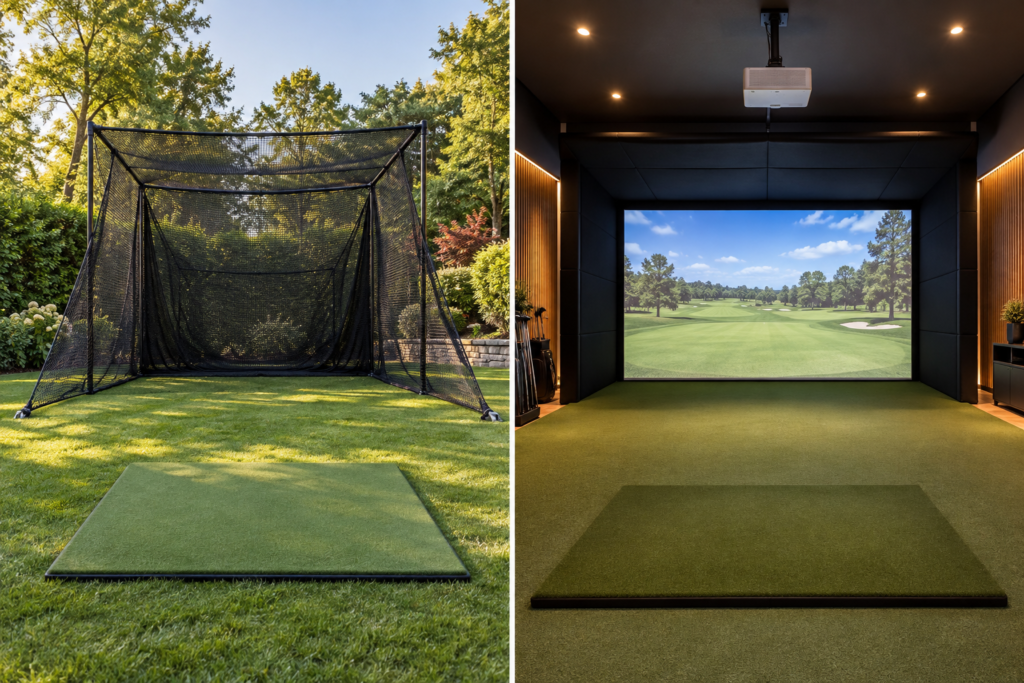
Golf net vs. impact screen: both can turn part of your property into a useful golf practice area, but they solve different problems. A net is built to catch golf balls. An impact screen is built to take strikes while displaying a projected simulator image. That distinction affects nearly everything else: the space you need, how permanent the setup feels, what it costs, and whether it makes sense outdoors.
The right home golf setup is less about chasing the fanciest option and more about working honestly with your available room. Ceiling height, full-swing clearance, nearby windows, wind exposure, and whether the area must still function as a garage or patio all matter. A setup that looks compact on a product page can become a bad fit quickly once a driver, a backswing, and a couple of innocent bystanders enter the picture.
Comparison Overview
Golf nets are commonly compared with impact screens because both let you hit real golf balls at home without sending them into the neighbor’s siding. A net is usually the simpler option: set it up, place a mat in front of it, and practice your swing, contact, and aim. Some nets are portable enough to move between a garage, driveway, patio, or yard, although outdoor models still need proper anchoring and weather management.
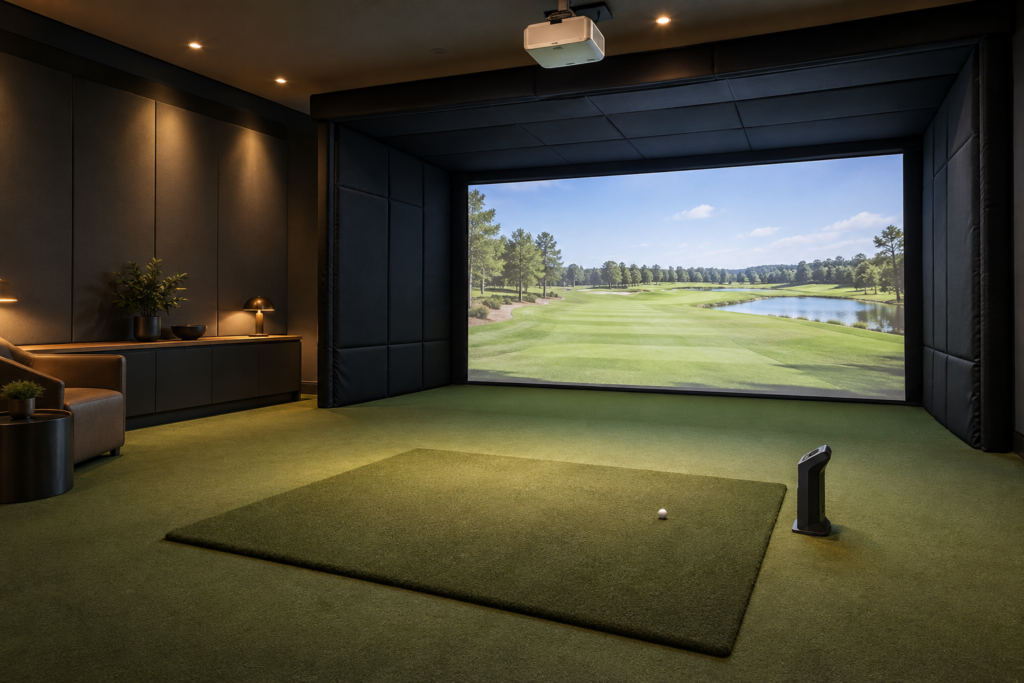
An impact screen is typically part of a fuller simulator bay that includes a frame or enclosure, hitting area, projector, and often a launch monitor. The screen provides a large, front-facing surface for simulated rounds and visual feedback. That can create a far more immersive setup, but it also requires more planning for screen tension, rear clearance, projector position, power, containment, and safe swing space.
Side-by-Side Comparison
| Criteria | Golf net | Impact screen |
|---|---|---|
| Main purpose | Catch balls during practice | Receive shots and display projected visuals |
| Basic equipment | Golf-rated net, mat, suitable containment | Screen, frame or enclosure, mat, suitable containment |
| Shot feedback | Compatible launch monitor needed for measured data | Compatible launch monitor needed for measured data |
| Simulator play | Can show results on a separate device | Can project results directly ahead |
| Space | Swing clearance plus specified hitting and rear distances | Swing clearance plus specified hitting and rear distances |
| Portability | Some models fold or move easily | Many setups are designed to stay assembled |
| Outdoor use | Only where the model permits it | Requires equipment suitable for the conditions |
| Total cost | Depends on net, accessories, and electronics | Depends on screen, enclosure, projector, and electronics |
Key Differences
A Net Catches the Ball; a Screen Becomes the Target
The biggest difference is also the simplest. A golf net is a containment tool. It catches the ball after impact, giving you a practical place to hit without requiring a full simulator environment. It may include a target, but it does not provide an image or virtual course experience on its own.
An impact screen provides a surface that can receive golf shots and display a projected simulator image. The launch monitor measures the shot, and compatible software generates the result—the screen itself does neither. You can also use a compatible launch monitor with a golf net and view the results on a phone, tablet, or computer. Choose a screen when you want the projected course or range directly in front of you.
The Real Space Requirement Is Your Swing
A portable net may have a smaller equipment footprint than a framed simulator bay, but its listed dimensions do not describe the whole practice area. You also need the manufacturer’s required hitting distance, clearance behind the net, and enough unobstructed room for your backswing and follow-through. Check those requirements before deciding that a net fits beside the car or underneath the garage door tracks.
An impact-screen bay needs room behind the screen for movement under impact, along with adequate space for the golfer, enclosure, and launch monitor. Follow the installation requirements for each component rather than assuming a standard distance will work. A basic net also needs rear clearance and a specified hitting distance, so compare complete setups before deciding which uses less room.
An Impact Screen Requires More Supporting Gear
A net can be a relatively straightforward setup: net, mat, balls, and enough clear space. You can add a launch monitor or alignment tools later, but the net itself does not depend on a projector, screen image, or dedicated enclosure to do its job.
An impact-screen setup becomes more involved quickly. To use the screen as a simulator display, you generally need projection equipment and a compatible launch-monitor setup, along with suitable mounting, cable management, and containment. That is not automatically a downside. For someone building a true home simulator, it is exactly the appeal. Still, it is a bigger project than opening a net and hitting a bucket of balls after work.
Outdoor Use Favors Simplicity
A golf net can make sense outdoors when the particular model is intended for that use and installed as directed. Follow its anchoring instructions and weather limits, and inspect the netting and frame before each session. Do not assume a portable net can remain outside year-round. Wind, sunlight, and moisture can affect its stability and condition.
An exposed impact screen is less practical for a mixed-use backyard. The screen needs controlled tension and protection from weather, while a projector, launch monitor, and power connections introduce another layer of vulnerability. If powered equipment is part of an outdoor build, the CPSC recommends outdoor-rated extension cords, keeping plug-connected equipment away from water, and using GFCI protection. For new outdoor circuits or uncertain conditions, a licensed electrician is the grown-up answer.
Portability and Permanence Pull in Opposite Directions
Golf nets are usually the better choice when your practice area has another job. Maybe it is a garage bay used for parking, a patio used for family dinners, or a driveway that needs to become a driveway again before Monday morning. A portable net can be moved or stored with much less fuss than a framed simulator enclosure.
An impact screen makes more sense when you can dedicate the space. Once an enclosure, screen, projector, and hitting area are dialed in, you probably will not want to dismantle the whole arrangement every weekend. The trade-off is convenience versus immersion: a net is easier to put away, while a screen is easier to leave ready for a full simulator session.
Performance and Everyday Use
Quick Range Practice Is a Net’s Strong Suit
For short practice sessions, a golf net is hard to argue with. Set up a mat, hit a few balls, work through wedges or irons, and move on with the day. It removes the trip to the range and keeps balls contained rather than scattered around the yard. That convenience can make practice more frequent, which is more valuable than owning an elaborate setup that rarely gets used.
The limitation is feedback. A net catches the shot, but it does not show full ball flight or automatically explain what happened. You can still work on strike quality, alignment, swing positions, and tempo, but you may want a compatible launch monitor if detailed shot data is part of your practice plan.
Simulator Play Gives an Impact Screen Its Advantage
An impact screen is the better fit when golf practice means more than hitting into a target. Paired with the necessary simulator equipment, the projected image connects each swing with a visible result, whether that means simulated course play, target practice, or a driving-range-style display. For players who get bored hitting ball after ball into netting, that extra engagement can be a meaningful reason to invest.
The downside is setup time and system dependence. If the projector, launch monitor, software, or connection needs attention, a quick session can become a troubleshooting session. Technology is great right up until it decides your golf night is an IT support ticket.
Safety Depends on the Entire Practice Area
Neither setup is safe simply because it catches the ball eventually. Side misses, high shots, rebounds, damaged netting, club strikes, children, pets, vehicles, windows, and overhead obstructions all deserve attention. A properly sized net or enclosure helps, but it cannot compensate for poor placement or a golfer taking a full swing in a cramped area.
Before buying, measure the available height, width, and depth and compare them with the requirements for your net, screen, enclosure, and launch monitor. Where there is adequate room, check the intended hitting position with slow, controlled no-ball rehearsals using your longest club. Include the entire backswing and follow-through. If you hesitate or change your motion to avoid an obstacle, choose another location or stick to putting. A slow rehearsal alone does not establish safe clearance for full-speed swings.
Shared Spaces Need a Low-Drama Setup
If the area is shared with vehicles, storage, patio furniture, or other people, a net is usually easier to live with. It can be placed in position when needed and removed before it becomes part of everyone else’s evening plans. A portable, outdoor-rated net is especially practical if you do not want a golf bay permanently claiming the backyard.
An impact screen can work in a shared garage or outbuilding, but only if the enclosure and hitting area can remain protected and undisturbed. Constantly moving screens, projectors, and alignment-sensitive equipment undercuts the convenience that justified the setup in the first place.
Durability and Maintenance
A golf net’s long-term condition depends on its materials, how often it takes full-speed shots, whether it stays outdoors, and whether the frame remains secure. Regularly inspect the netting, seams, frame joints, and anchors for wear or damage. Outdoor storage adds sun, moisture, wind, and storm exposure to the list of concerns, so even a model intended for outdoor use should be protected or stored as its manufacturer recommends. Depending on the design, replacing a worn net section or accessory may be simpler than repairing a larger simulator system.
Impact screens also wear over time, particularly in the most frequently struck area. Their performance depends on appropriate tension and clearance behind the screen. Pulling a screen excessively tight can increase rebound concerns, while improper tension can also affect the hitting surface and image. An impact-screen setup has more components to maintain, including enclosure padding, frame hardware, projector placement, cables, and electronics. More parts create more ownership work, though a dedicated, protected indoor setup avoids many of the weather-related problems that challenge outdoor nets.
Cost and Overall Value
A golf net is generally the value-focused path because it can deliver the core benefit—hitting real golf balls at home—with fewer required components. If your goal is to make more swings, stay loose, or work on contact without building a dedicated simulator room, a net, mat, and appropriate safety accessories may be enough. The less elaborate option is not automatically the lesser option. It may simply be the one that gets used three times a week instead of admired from the garage doorway.
An impact screen can justify the larger investment when you want projected simulation, visual feedback, and a more complete golf environment. The cost is not just the screen; it can include enclosure materials, a projector, launch-monitor equipment, and electrical or room-preparation work. That added expense makes sense when you have a protected, dedicated space and expect to use simulator features regularly. It is harder to justify if you only need a place to hit a few balls before dinner.
Who Should Choose Each Option
The Garage Golfer With Limited Flexibility: Golf Net
A golf net is usually the better fit if your garage still needs to hold vehicles, tools, storage bins, or the occasional mystery box nobody has opened since 2014. Look for a net that fits the available footprint, but confirm complete swing clearance before treating any product dimensions as a green light.
The Dedicated Home Simulator Builder: Impact Screen
Choose an impact screen if you have an enclosed area that can become a proper simulator bay and projected play is a major part of the plan. The extra room, installation effort, and equipment make more sense when the setup can stay assembled and protected.
The Mixed-Use Backyard Owner: Golf Net
A portable, outdoor-rated golf net is generally the more practical choice for a backyard that must remain flexible. Secure it according to the manufacturer’s instructions, monitor weather conditions, and do not assume that any net is safe to leave outside year-round. A screen-and-projector arrangement is usually better reserved for a covered or enclosed structure.
The Golfer With Tight Ceiling or Side Clearance: Neither Yet
If driver clearance is questionable, pause before buying either option. A net does not solve a low ceiling, and an impact screen does not make a narrow bay safer. Confirm the equipment’s clearance requirements and account for your entire backswing and follow-through with your longest club. Slow, controlled no-ball rehearsals can help identify obvious obstructions, but they do not establish safe clearance for full-speed swings.
Final Verdict
Choose a golf net when you want a straightforward home practice setup that can work in a garage, driveway, patio, or yard with proper placement and anchoring. It is the practical choice for range-style practice, flexible spaces, and golfers who value portability more than projected visuals. Its limitations are equally clear: it does not create a simulator experience on its own, and it cannot replace careful planning for swing room and containment.
Choose an impact screen when you have a dedicated, protected space and want projected simulator play. It asks more from your room, budget, and installation plan, but it can deliver a more immersive experience if you will use those features often. Neither option wins everywhere. The best home golf setup is the one that fits your actual space, accounts for the surrounding hazards, and makes you want to hit more balls.
Frequently Asked Questions
Can you use a golf net with a launch monitor?
Yes. A golf net can be paired with a launch monitor if the device supports net-based use and your available space meets its setup requirements. The net catches the ball, while the launch monitor provides shot data.
Does an impact screen need space behind it?
Yes. Impact screens generally need clearance behind them to manage impact and rebound. Follow the recommendations for the specific screen and enclosure system you choose.
Is a golf net safe to use in a backyard?
It can be used in a backyard with proper positioning, adequate surrounding clearance, secure anchoring, and regular inspection. Keep people, pets, vehicles, and breakable objects out of the potential shot area, and remember that side misses and high shots may escape the main net.
Can an impact screen be used outdoors?
It can be installed in a properly protected outdoor structure, but exposed use is more complicated because the screen, projector, power connections, and electronics need weather protection. A net is usually the simpler outdoor choice.
How high should the ceiling be for a home golf setup?
There is no single ceiling height that works for every golfer. Your height, swing shape, club length, and the clubs you plan to use all matter, so test full-swing clearance before buying equipment.